I’ve been testing a Crimean Tatar for individual I2a-Y3120 SNPs at YSEQ. He traces his male line to Baghatır village, in Backchisaray rayon of Crimea. The sample is designated as I-S20602 (equivalent to I-Y3120) in the Crimean Tatar project on FTDNA from his Family Finder test. He informs me that his male line ancestors belonged to the Mountain Tat subgroup of Crimean Tatars that inhabited the mountainous southern part of Crimea.
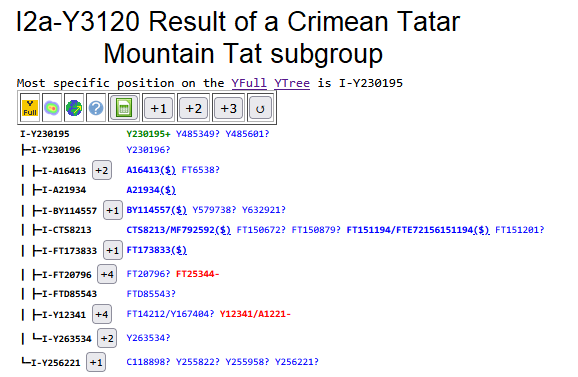
His most specific subclade I have so far confirmed by SNP testing is I2a-Y3120>Z17855>Y230195 and negative for I-FT20796 and I-Y12341. Men of this line all descend from a Most Recent Common Ancestor who lived around 350 BCE (FTDNA estimate) and they are now found from Austria to Albania to Mordovia, Russia to Uzbekistan. It is no longer cost effective to test for individual SNPs so I’m starting to collect donations for his YSEQ WGS test, now that we have a rough idea of his placement.
Mountain Tats in particular are believed to have diverse origins, potentially descending from a mix including some or all of the various ancient peoples who had once inhabited the region.
I believe that upgrading this sample to WGS provides a great opportunity to potentially learn more about:
- The ethnogenesis of Mountain Tatars
- The geographic origin of the I2a-Y3120>Z17855>Y230195 Most Recent Common Ancestor
- The geographic origin of a younger subclade, if the sample ends up being more closely related to any of the other samples.
Interestingly, this sample is in a completely different subclade of I2a-Y3120 than another Crimean Tatar in the FTDNA project. If there were an exclusively Crimean Tatar subclade of I2a-Y3120, then it is possible that their Most Recent Common Ancestor may have been living in Crimea or nearby. Depending on how far back the common ancestor is estimated to have lived, certain ancient populations can be considered more or less likely (or impossible) as being ancestral, based on our knowledge of the migration and settlement of ancient tribes, groups or confederacies.
I think it is also relevant to mention that the oldest ancient sample that is probably I2a-Y3120 (low resolution could only confirm he is at least positive for parent clade I2a-CTS10228) was also found in Crimea, in the Kerkinetida necropolis, located within the modern city of Yevpatoria. His autosomal DNA was categorized as belonging to a group “SEra_West” in the “non-Scythian” section of the table.
So if we assume that AS13 was in fact positive for I2a-Y3120, then a Crimean Tatar who is positive for this line could theoretically descend from male line ancestors who had been in Crimea for over 2000 years (because we know at least one such I2a-Y3120 man was living there 2000 years ago).
I’m currently accepting donations for a WGS+ test (399 Euro) for this Crimean Tatar at YSEQ. Please send any donations via paypal to hunterprovyn@gmail.com (or use link below) with subject “Crimean Tatar WGS”.
Donation link: https://www.paypal.com/paypalme/phylogeographer
The tester is unable to contribute funds for his WGS due to the ongoing sanctions but has agreed to pay for the YFull analysis.
For more background on I2a-Y3120, you may find my recent video interesting. I show that the deeper origin of this subclade in the Iron Age is likely around Bulgaria or Romania, the only place where this subclade’s next closest relatives have been found in the Bronze Age. I also introduce my theory of an Odrysian Thracian-mediated migration of this line to the Crimean and Taman peninsulas, by way of the Spartocid dynasty that ruled the Bosporan kingdom.